
ENGLISH BELOW
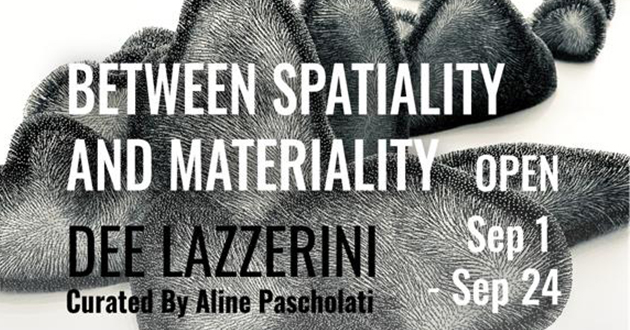
O que une as criações de Dee Lazzerini apresentadas na mostra Between Spatiality and Materiality – Entre espacialidade e materialidade, em português, da qual tenho o imenso prazer de ser a curadora -, na galeria The House of Arts, em Miami, vai muito além de sua aparência e material em comum: poliuretano esculpido e policromo, repleto de alfinetes.
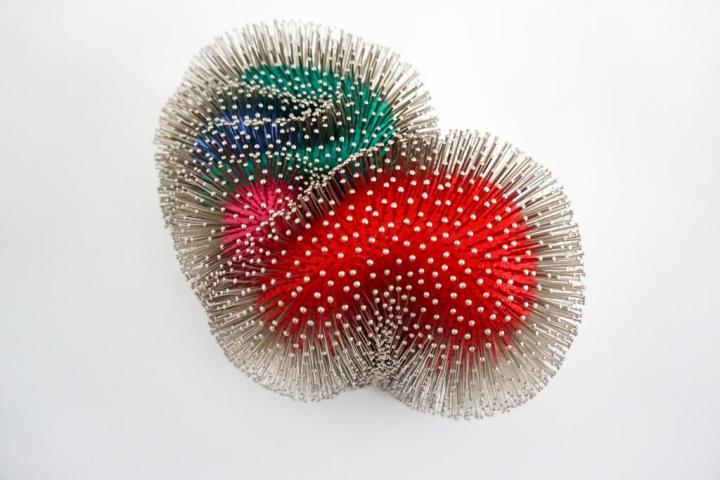
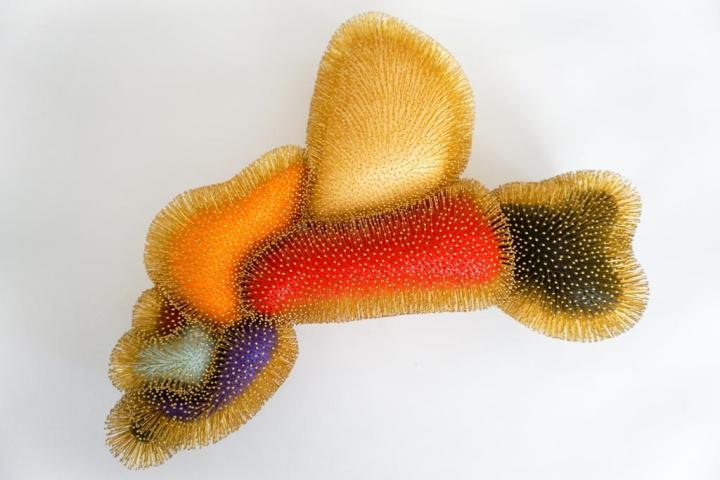
Nas treze obras que compõe África: Dúvidas ou Débitos? (2021), cada uma delas representando um ou mais países, tal qual nos mapas contemporâneos, as cores fazem alusão a elementos da paisagem e da cultura de cada região – tons terrosos para o Norte, dominado pelo deserto, e cores vivas em referência às roupas coloridas de países como a Nigéria e o Congo. Nesses últimos, assim como no Senegal, Guiné-Bissau, Gana, Togo, Benim, Angola e Moçambique, do século XVI ao XIX, a exploração da população pelo tráfego humano foi intensa. Nas esculturas que os representam, os alfinetes dourados dos locais menos explorados foram substituídos por prateados, com uma perda de brilho que representa a dor causada por esse sequestro; com esses alfinetes podendo também ser elementos que marcam um ponto no mapa. Além disso, a maneira na qual as treze criações estão apresentadas aqui, em linha, ao invés de na forma real do continente, nos lembra a divisão da África pelas potências europeias colonizadoras, sem levar em consideração as populações locais e suas etnias – por si só uma violência -, assim como a diáspora africana por todo mundo. Trata-se de uma África roubada, deposta de seu ouro, seu elemento mais precioso: seus próprios habitantes.



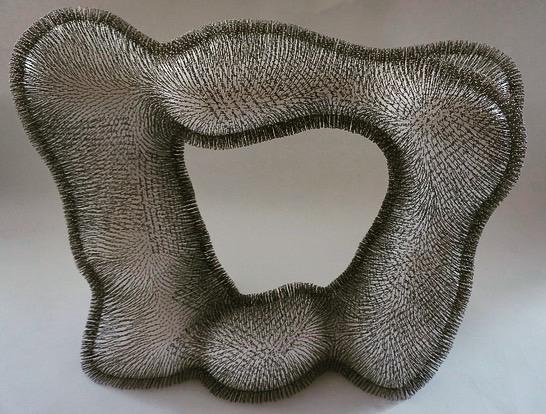
E quem sabe são essas feridas e partes despedaçadas que procuram seus pares – não só da África e do próprio artista, mas de todos nós, através de sua contemplação -, que a escultura Entre a música e desejo (2023), da série Cal, pretende curar. A cor branca faz uma clara alusão ao gesso que recobre os membros quebrados, em recuperação; gesso, que, tal como a cal. é obtido através do processo de calcinação. *
Já os fragmentos de escrita apostos na superfície branca lembram aqueles escritos pelos amigos e familiares no gesso que pretende imobilizar os ossos, trazendo a cura através do afeto. Essa escrita automática – terapêutica, nesse caso – era uma prática querida dos surrealistas, desde fundador do movimento, André Breton, autor do Manifesto do surrealismo (1924), através da qual deixavam fluir o inconsciente em palavras rabiscadas sem o controle da mente consciente, resultando, assim, em composições guiadas pelo acaso. Essa busca pelo inconsciente foi inspirada por Freud, de quem eram os fãs número um. Entretanto, enquanto o médico propunha sua descoberta no intuito de trazer a cura, os artistas, por sua vez, desejavam deixá-lo fluir solto, sem amarras. E, aqui, Dee Lazzerini nos traz um mix dos dois.


A cura, inclusive, faz parte integrante da prática do artista, que trabalhou durante muitos anos na construção de corpos artificiais. Em suas obras, parecemos ver ora membros, ora núcleos flutuantes, como os elementos que compõe sua África, que aludem a nano biologia – Núcleos flutuantes, é, inclusive, o título da primeira série na qual ele aplicou alfinetes em suas esculturas de poliuretano. Os alfinetes, ao mesmo tempo delicados, frágeis e agressivos, lembram instrumentos que podem incutir tanto a dor e a violência, quanto a reparação e a reconstrução, desde a cirúrgica até a da costura, universo ao qual pertence o alfinete. Essa linha coroada por um ponto, que é o início de toda arte: do ponto à linha; da linha às formas – elementos considerados pelos abstracionistas geométricos, junto à cor, como os “verdadeiros”, pois os únicos intrínsecos ao universo da arte, sem referência direta ao mundo exterior, ao nosso mundo.
Além disso, a relação entre o micro e o macro é importantíssima na poética do artista, que nos conecta com esses dois extremos – o micro e o macrocosmo tendo sido um conceito de grande valor em diversas filosofias, doutrinas místicas e esotéricas, que ligam o corpo humano ao universo, do pitagorismo aos alquimistas; os alquimistas que, inclusive, pretendiam transformar a matéria, tal qual fazem os artistas, de maneira tanto física, quanto metafórica. Através desses alfinetes colocados na superfície de suas obras, temos uma ligação entre espacialidade e materialidade, com a criação de um espaço vazio, tal qual àquele no qual flutuam os elétrons ao redor dos átomos. Então, a matéria de tudo no universo conhecido pelo homem é repleta de espaços vazio, os quais são materializados, em maior escala, nessas esculturas, e, assim, há uma correspondência visual entre o micro e o macro que evidencia a ligação entre tudo que existe.
Por fim, a terceira obra da mostra, da série Núcleos flutuantes, propõe uma aglomeração de núcleos flutuantes, que não deixa de nos lembrar um organismo que cresce infinitamente. Esse crescimento pode aludir desde aos experimentos laboratoriais em escala microscópica, os quais realizava o artista em sua jornada como cientista durante seu doutorado na França, quanto ao aumento galopante da população global. Sua cor não deixa de fazer pensar nos musgos e líquens, que crescem ao seu bel prazer em troncos e pedras de uma floresta, em uma natureza que cresce até tomar todos os espaços que os seres humanos lhe abandonaram – pensemos nas ruínas de Angkor, no Camboja, cobertas pela mata. Além disso, a forma fálica da escultura pode ser vista como uma referência à fertilidade, tanto do homem, quanto da natureza, através desse símbolo reverenciado desde o início dos tempos, quando a sobrevivência dependia da fecundidade da terra, dos animais e dos seres humanos – a fertilidade dos seres vivos que se concretiza através da multiplicação de uma pequena célula em milhões delas. Essa forma fálica, que, enfim, está presente milhares de vezes em cada uma das obras do artista, através dos alfinetes, ligando, mais uma vez, o micro e o macro.

*Com a contribuição do geólogo Wellington F. Marchesin
Serviço:
Between Spatiality and Materiality
Dee Lazzerini
De 01/09/2023 a 24/09/2023
De segunda a sexta-feira das 11 às 19h
Sábados das 12h às 18h
Domingos somente com agendamento
The House of Arts
100 NW 36th Street
Miami FL 33127
Estados Unidos

ENGLISH VERSION
The micro and macrocosmos at Dee Lazzerini’s ‘Between Spatiality and Materiality’ in Miami
What connects Dee Lazzerini’s creations presented at the show Between Spatiality and Materiality – which I have the immense honor of being the curator – at The House of Arts gallery in Miami goes far beyond their shared appearance and material – sculpted polychrome polyurethane covered with head pins.
In the thirteen works that compose Africa: Doubts or Debts? (África: Dúvidas ou Débitos? – 2021), each representing one or more countries, just like on contemporary maps, the colors allude to elements of the landscape or the culture of each region – earthy tones for the North, dominated by the desert, and bright colors in reference to the colorful clothes from countries like Nigeria and Congo. In those, as well as in Senegal, Guinea-Bissau, Ghana, Togo, Benin, Angola, and Mozambique, there was an intense exploitation of the population by human traffic from the 16th to the 19th century. In the sculptures representing these countries, the golden head pins of the less explored places have been replaced by silver ones, with a loss of shine that symbolizes the pain caused by this abduction; the pin also being something that marks a point on a map. Besides, the way in which the thirteen are showed here, in line rather than in the actual form of the continent, reminds us of the partition of Africa by the colonizing European powers, who didn’t take in consideration the local populations and their ethnicities when they divided the territory – a violence per se -, as well as the African diaspora all over the world. It is a stolen Africa, stripped of its gold, its most precious gift: its own inhabitants.
And maybe it is those wounds and shattered pieces looking for their lost parts that the sculpture Between Music and Desire (Entre a música e o desejo – 2023), from the series Lime (Cal), intends to heal – not only Africa and the artist himself, but all of us, through the contemplation of it. The white shade makes a clear allusion to the plaster that covers broken limbs during recovery; plaster, which, like lime, is obtained through the calcination process. *
The writing fragments placed on the white surface remind those written by friends and family on the plaster that intends to immobilize broken bones, thus, bringing healing through affection. Automatic writing – therapeutic, in this case – was a favorite practice of the Surrealists since the founder of the movement, André Breton, author of the Manifesto of the Surrealism (1924). The idea was to let the subconscious flow thorough scribbled words without the control of the conscious mind, resulting in compositions guided by chance; this search for the unconscious being inspired by Freud – of whom they were number one fans. However, while the doctor proposed exploring the unconscious mind to bring cure, the artists, in turn, wanted to let it flow freely. And here, through his works, Dee Lazzerini brings us a mix of both the ideas.
Healing is also an essential part of the artist’s practice, who worked for many years building artificial body parts for medical purposes. In his works, sometimes we can see shapes that look like limbs or floating nuclei – such as the elements that compose his Africa -, which allude to nanobiology. In addition, Floating Nuclei (Núcleos flutuantes) is precisely the title of the first series in which he added head pins to his polyurethane sculptures; pins that are at the same time delicate, fragile, and aggressive, and resemble instruments that can cause pain and violence, as well as repair and reconstruction, from surgery to sewing – the latter being the universe to which the head pins belong. Moreover, the pins are visually a straight line crowned by a dot, which is the beginning of all art: from dot to line; from line to shape – elements considered by the geometric abstractionists, along with color, as the “true” ones, the only intrinsic to the art universe, bearing no direct reference to the outside world, to our world.
Besides, the relationship between the micro and the macro is extremely important in the artist’s research, which connects us with these two extremes – the micro and the macrocosm, which link the human body to the universe, being a concept of great value in various philosophies, mystical and esoteric doctrines, from Pythagoreanism to the alchemists; the alchemists who intended to transform the matter, just as artists do, both physically and metaphorically. Through these pins placed on the polychrome polyurethan surface, we have a link between spatiality and materiality, with the creation of an empty space, just like the one in which electrons float around atoms. This way, the matter of everything in the known – by man – universe is full of empty spaces, which are materialized on a larger scale through these sculptures; the visual correspondence between the micro and the macro highlighting the connection between everything that exist.
Finally, the third work in the show, part of the Floating Nuclei (Núcleos flutuantes) series, proposes an agglomeration of floating nuclei that seems like an infinitely growing organism. This growth can allude to microscopic scale laboratory experiments – which the artist carried out on his journey as a scientist during his doctorate in France -, as well as to the galloping global population increase. Its color reminds those of mosses and lichens, which grow at will on forests’ trunks and stones, the nature spreading until it takes up all the spaces human beings have abandoned to it – let’s think of the ruins of Angkor, in Cambodia, covered by green. In addition, the sculpture phallic shape can be seen as a reference to the fertility of both man and nature – a revered symbol since the beginning of times, when survival depended on the fecundity of land, animals, and humans; the fertility of living beings becoming true through the multiplication of a small cell in millions of them. This phallic form, which, after all, is present thousands of times in each of the artist’s works through the head pins, links once again the micro and the macro universes.
*With contributions from the geologist Wellington F. Marchesin
Between Spatiality and Materiality
Dee Lazzerini
From September 1rst to September 24th 2023
Monday-Friday from 11 am to 7 pm
Saturday from 12pm to 6pm
Sunday by appointement
The House of Arts
100 NW 36th Street
Miami FL 33127
USA
Comprando qualquer produto na Amazon através desse link, você ajuda a manter o Artrianon e não paga nada a mais por isso.


 Artrianon